

It’s safe to say 2026 hasn’t really gone to plan! My last post was back in March; since then, spring has sprung, summer arrived and decided this year it was “very hot”, and now we are in September. The apple tree is burgeoning under the weight of too many apples, and the garden, which has been scorched all summer long, is thankfully breathing sighs of relief as some much-needed rain passes through these last few days.
So why the long break in posting?
Back in March, my husband was diagnosed with a venous ulcer in his leg. If you’re not familiar and not squeamish, look it up. I don’t recommend getting one. After seven months off work, copious amounts of paracetamol and ibuprofen, and some rather fetching compression socks, it has now thankfully just about fully healed.
While it has been lovely to spend so much time together, it has meant putting on hold many of the posts and projects I had in the pipeline for this year. But I haven’t been idle!
Beard Tax:
I’ve started writing a funny YA story based around the myth of Henry VIII’s proposed beard tax. I say myth because there is no historical evidence he ever intended to introduce such a levy, but it is a myth that seems to endure and one worthy of a fun story.
The Ever After Archives:
This is a project I’ve been thinking about for some time, and I’ve finally managed to mould it into something that a) makes sense and b) is not so hugely overwhelming I would never know where to start! At the core of this project is a story, or rather a series, with Cinderella taking the lead. She’s accompanied by several grumpy fairy godmothers, at the mercy of an unlikely duo, and a wand that wants to take over the world!
I could go on, but I think I’ll stop here. I recently wrote out a list of all the projects I am working on, have been outlined, are in the pipeline in some form or other, or are just ideas. That list runs to 20 items, and that doesn’t include titles which will become a series.
World Building With AI
AI is definitely the new Marmite; you either love it or hate it. I kind of sit in the middle of the two, if that’s possible. I like to use it to help me thrash out ideas, for research, and to help me “build the scaffolding” within my notes so I have more coherent story outlines, product ideas or marketing help.
This year I embarked on a world-building exercise. I’ve built worlds before, but not in the way this project took me.
It began with me asking ChatGPT about clipart bundles, which I was thinking about adding to one of my Etsy stores. The clipart question morphed into stationery and ephemera bundles, and then it said, “Everyone is doing generic clipart these days. Frankly, it’s a race to the bottom.”
I couldn’t disagree. Every clipart bundle I’d seen or been served as an ad on social media looked just like the one I’d seen the day before, and the day before that. All were from different stores or creators. So, I proposed niching down:
“Let’s make it gothic/dark academia based!” I typed proudly.
“Great idea!” It responded. “That niche is really popular.”
This is code for ‘already very saturated.’ I suggested we went down the Kawaii route, make it spooky-cute, not terrifying. It agreed, but then suggested:
“As you are really good at world building, let’s build a world based on this niche. We can call it ‘The Ashcroft Institute of Archane Natural History.’
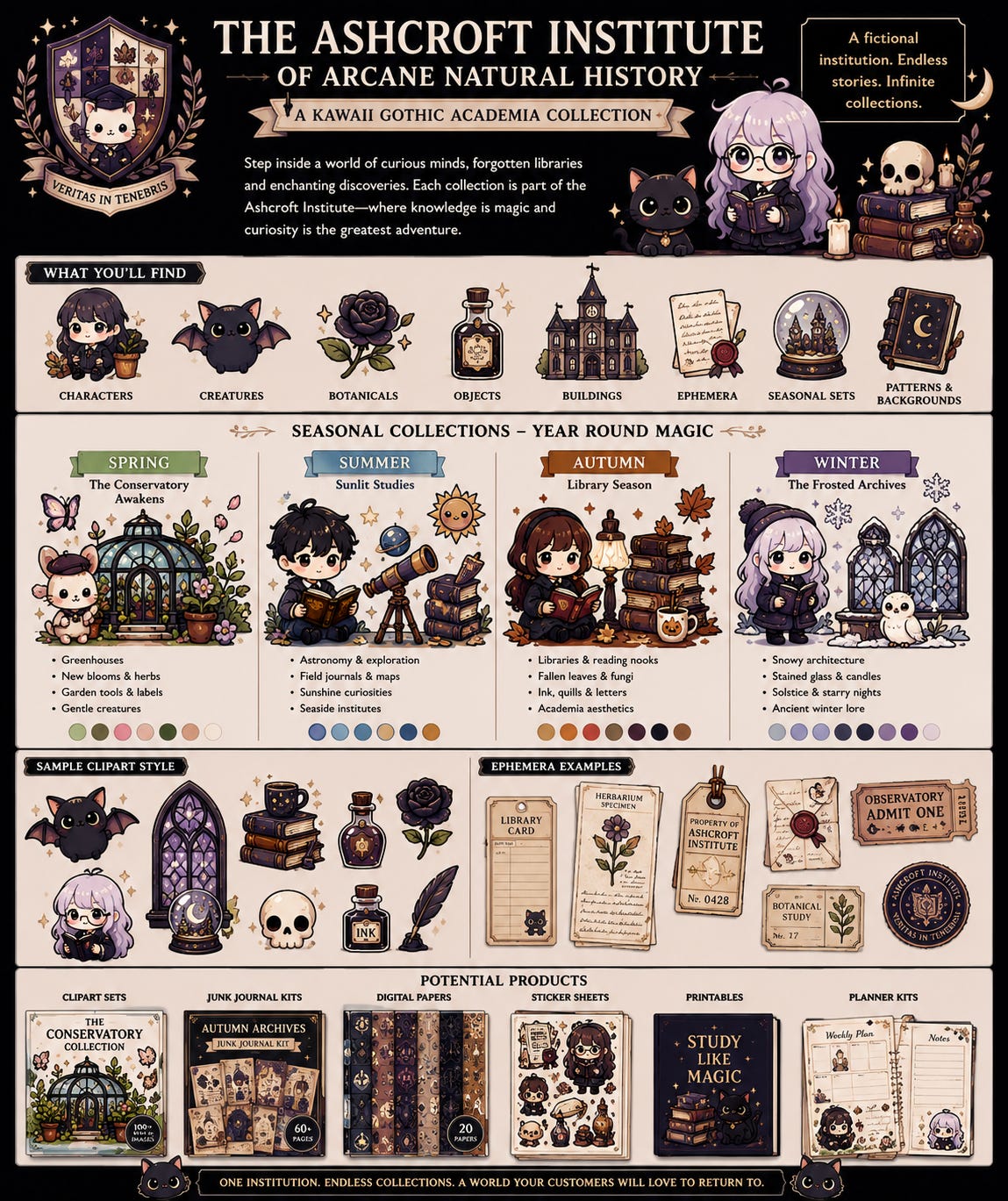
I wasn’t keen on the name, but the little infographic it created for me is very cute and was sort of working along the right lines. I was starting to feel this project getting bigger and bigger, and it had already moved a long way from what I originally set out to create. AI has a habit of doing that; ‘falling down a rabbit hole’ is what it is usually called, and to be honest, you can end up falling into one that is very deep and with many off-shoot tunnels!
I decided to stick with it, though. I came up with a new name - Candlewick Castle: The Archane Archives. I created some outline lore to get it started, a long list of characters and locations around the castle estate. Then ChatGPT said, “It’s time to write all this up in your World Bible.”
It then proceeded to create an outline document for me, detailing what a World Bible is, what it isn’t, and all the different sections I would need to write before the finished bible could be created. The point of this? It is to set in stone all the different elements of the world and therefore ensure consistency when writing about it, when illustrating it, when promoting it. But creating a World Bible is no mean feat, and after looking at all the different sections needed, I realised it would take me months, if not years, to create it!
I switched to a different AI; Claude this time, and asked it to write up the Candlewick Castle World Bible for me. It was still a couple of weeks of work before I got it finished. But armed with this, I went back to ChatGPT for my ‘TA-DA!’ moment.
“Fantastic!” It responded after reviewing the file. “Now you need to build your Production Bible.”
A Production Bible is the guide that states colour palettes, how characters move and express themselves, and their character traits. It also defines locations, flora and fauna, objects, and anything else that is relevant. If you think about production houses such as Disney, DreamWorks, and Studio Ghibli, this is the kind of prep work they go through before every project can commence. Back to Claude I went.
Luckily, the Production Bible is not as long as the World Bible, and the two together give you something so complete and easy to reference, I’d happily describe it as a work of art in itself! And there it was: Candlewick Castle - The Archane Archives. Complete with dragons, a government spy in the form of a cat, several ghosts and a hapless trio of suits of armour.
I have to say I’m very proud of Candlewick Castle and its potential. Although I used AI to do a lot of the heavy lifting, the whole thing came from my own imagination, from the name to the characters, the different locations, the myth and lore that surrounds it, and even the collections created for the rest of this year.
As I have already said, the purpose of this was to create themed clipart, stationery and ephemera bundles to sell on Etsy. Every product would be based around the seasonal collections I had designed, and made available in a digital format. But when I launched into production, I just wasn’t feeling it with what was being created. Using AI to generate this stuff does mean you can do it quickly, but you do lose some creative freedom when you compare it to drawing by hand, not to mention that ‘human touch’. And, when I looked at what I’d created, it was good, but somehow didn’t seem to do Candlewick justice. It was time to pivot.
In my next post, and it won’t be in six months, I promise; I’ll introduce Candlewick Castle and the product I’ve created for you all.
So, stay tuned!